Late Summer in the Cottage Garden: What I’m Learning as I Go
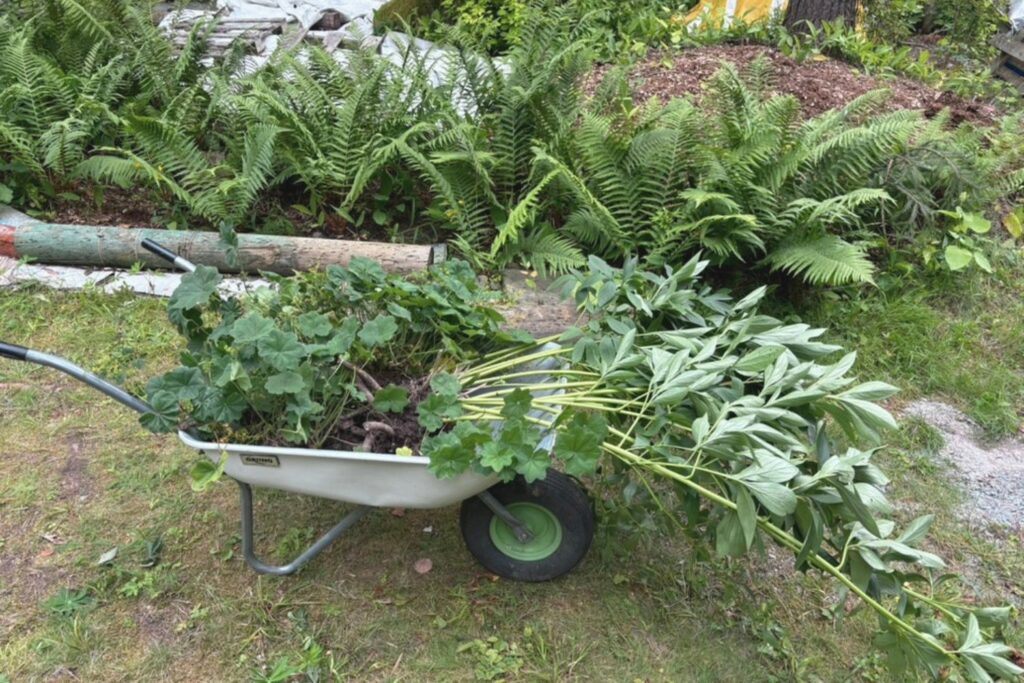
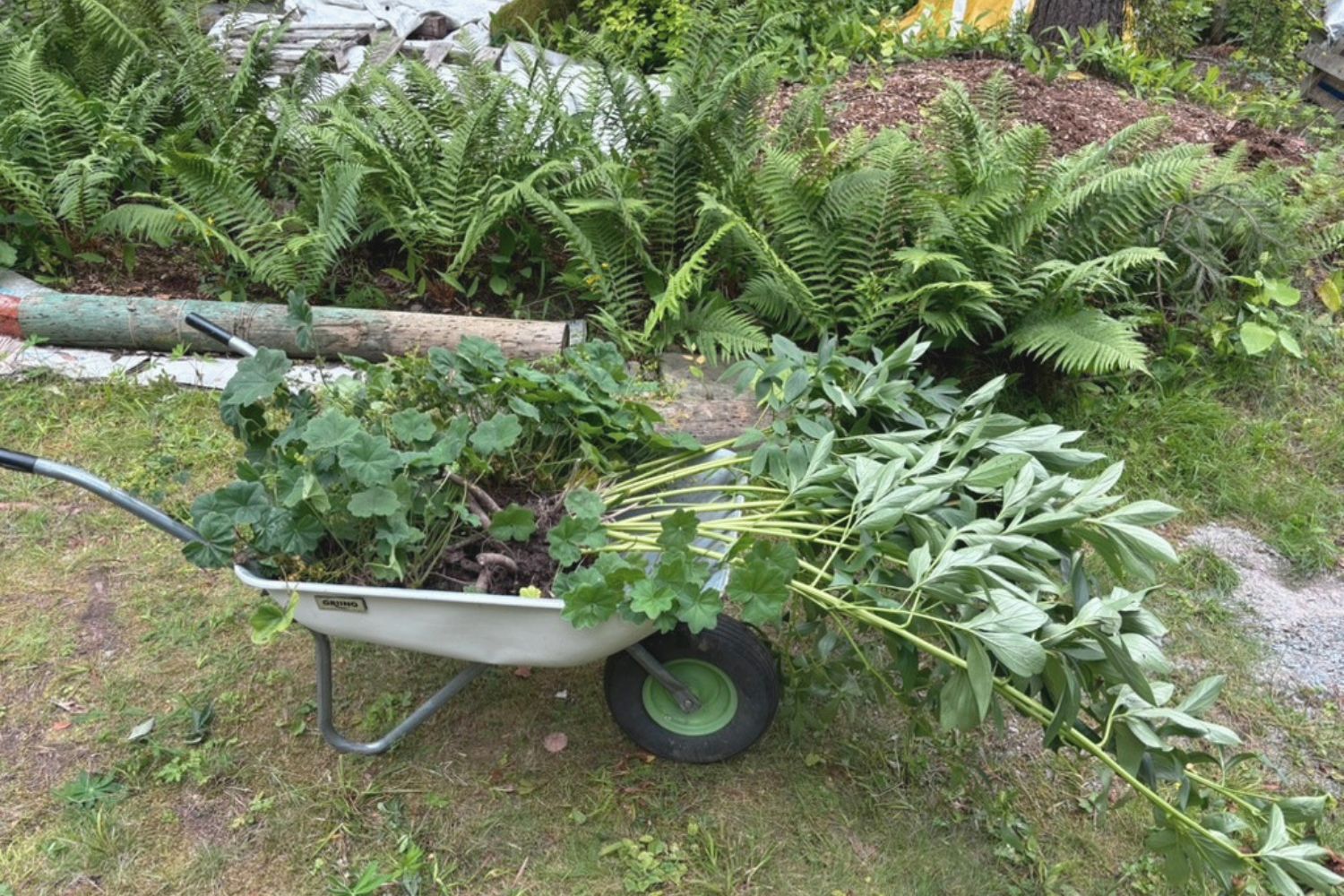
There’s a wheelbarrow that’s been living permanently by the shed this summer, and if you looked at it on any given afternoon, you’d probably find it half-full — a few pots of lady’s mantle waiting for a spot that hasn’t decided itself yet, a peony too large for its current container, roots already reaching for more room than they’ve been given. It’s become a kind of honest snapshot of where the garden actually is right now: not finished, not really even close, but very clearly in motion.
I didn’t grow up gardening. Nothing about this came naturally or early. What I have instead is a patch of overgrown ground around an old cottage, a fairly stubborn refusal to hire someone else to do it for me, and an ever-growing appreciation for how much a garden teaches you simply by making you show up and pay attention to it, season after season, whether or not you know what you’re doing yet.
This is not a finished-garden post. I don’t have one of those to offer. What I have is late summer — cut flowers wilting a little faster than I’d like, one flower bed that’s finally starting to look like something, and a climbing rose currently growing in exactly the wrong place because I planted it there anyway.
The Bed by the Parking Space
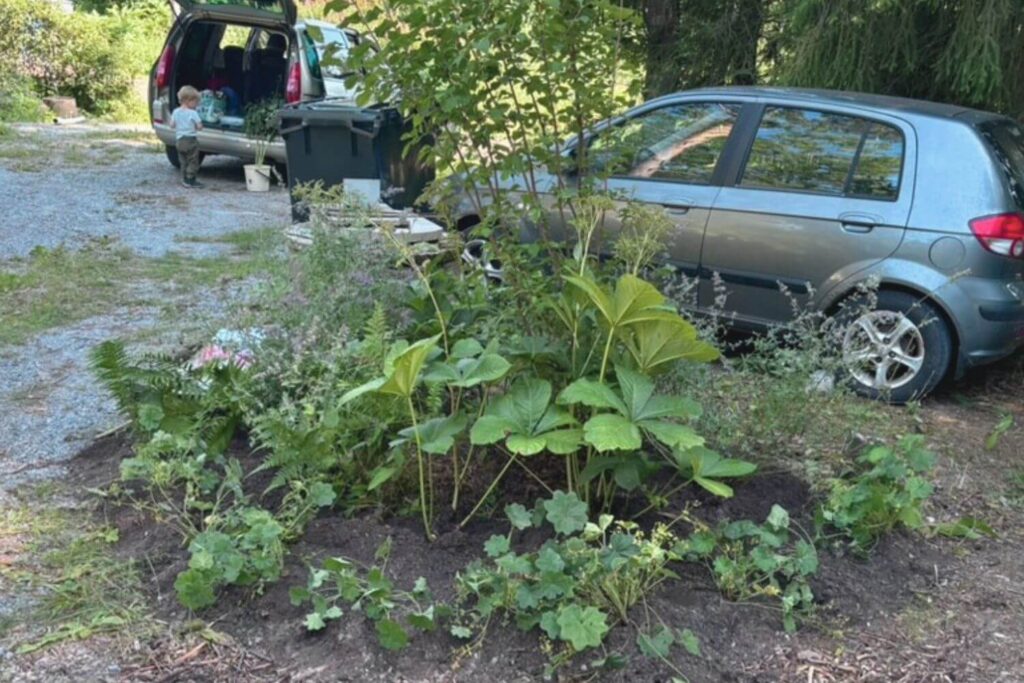
I’ll be honest about this one before anyone else points it out: the flower bed I’m proudest of this summer sits right next to the gravel parking area, which means every photograph of it also includes a corner of car and, somewhat less romantically, the storage container behind it. It is not the most flattering backdrop a flower bed has ever had, and I’m already thinking about what might eventually screen it a little — something evergreen and reasonably fast-growing, so the view softens without waiting another decade for it. For now, though, I’ve stopped waiting for the perfect spot to appear before planting anything in the meantime.
The bed itself used to hold nothing but a scatter of ferns and one small, self-seeded spruce sapling, quietly claiming the ground the way spruce always seems to when nobody’s looking. Both had to go before anything else could — the ferns moved elsewhere on the property, the little spruce given away to someone with more room for it to grow into a proper tree. What went in after, in the end, was a mix I’m genuinely happy with: a Beauty of Moscow lilac at the back, its pale, almost blush-white blooms clustering densely enough in spring to be worth the wait; false spirea in front of it, with its narrow, almost fern-like leaflets that catch the wind in a way I didn’t expect to enjoy as much as I do; a generous clump of lady’s mantle along the edge, the kind of plant that holds a single bead of morning dew in the center of each leaf like it’s showing off on purpose; and a low, spreading clump of Walker’s Low catmint tucked into the front corner, mostly because I liked how it smelled every time I brushed past it while weeding everything around it.
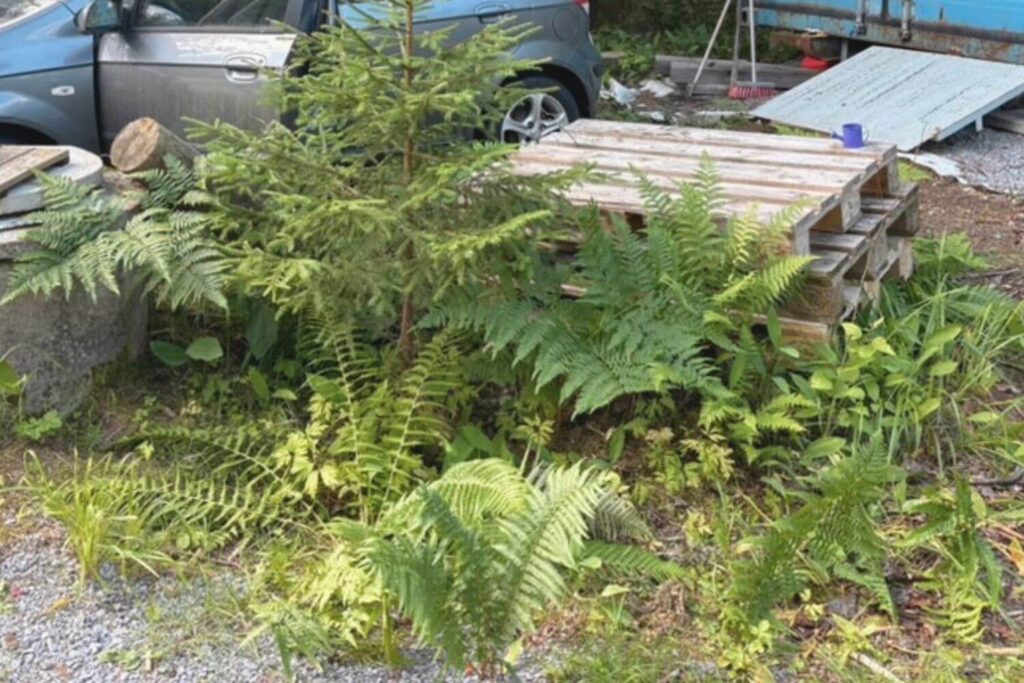
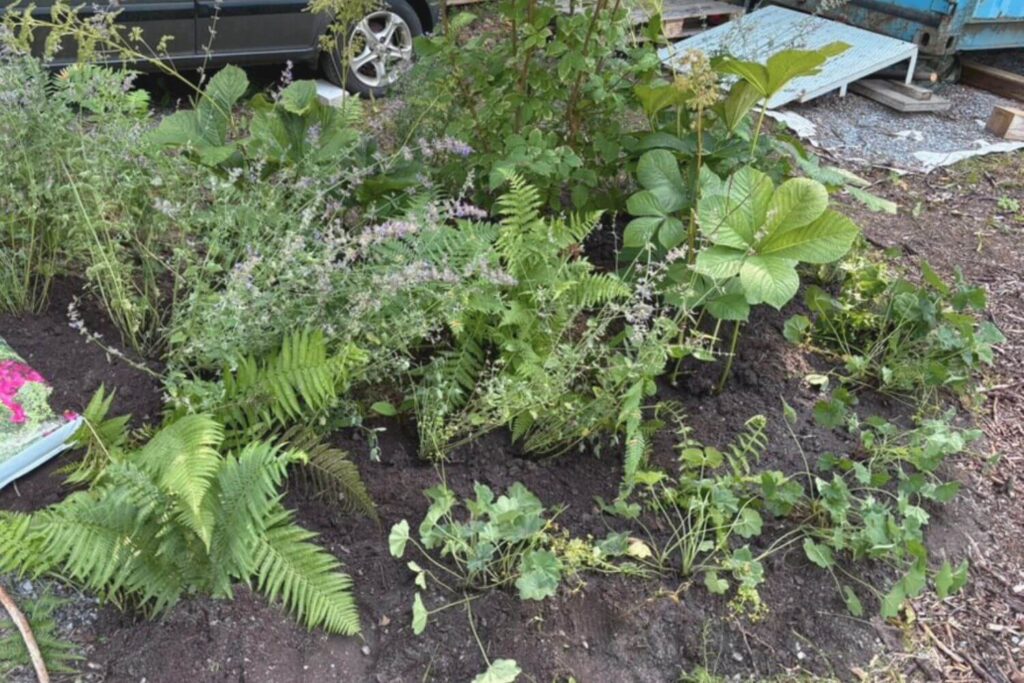
The before and after of this bed is the closest thing I have this summer to real, visible proof that any of this is working. Before: a scatter of ferns and a lone spruce sapling claiming ground that wasn’t really meant for it. After: still young, still filling in, definitely still photographed with a car in the background — but genuinely, unmistakably a garden now, in a way it simply wasn’t in June.
What the Wheelbarrow Knows
If you want an honest picture of where a garden actually is in its process, I’ve decided the wheelbarrow tells you more than any finished bed does. Mine has spent a good part of this summer as a kind of holding pattern — more lady’s mantle than I had a clear plan for, a peony that had outgrown its pot before I’d figured out where it belonged, both of them sitting there in soil and shadow while I worked out the answer one section at a time rather than all at once.
Behind it, just visible in most of the photos I’ve taken of that wheelbarrow, is the fern bed — the one part of the garden that required almost no convincing to look established. Ferns, I’ve learned this summer, are remarkably forgiving of a gardener who’s still figuring things out. They ask for shade, a bit of moisture, and otherwise mostly manage themselves, unfurling new fronds through the season with a patience I’ve started trying, with mixed success, to borrow for the rest of the garden.
I think this is the part of gardening nobody quite prepares you for: how much of it happens in exactly this state, mid-transfer, root-bound, waiting. Not the planted bed, not the finished corner, but the wheelbarrow stage — plants that know where they’re going even when you don’t yet, patient in a way that puts your own impatience gently in its place.
The Rose That’s in the Way, On Purpose
And then there’s the rose. I was given a Flammentanz climbing rose this summer — a proper, established plant, not a small starter — and for a while I genuinely considered parking it somewhere out of the way, in a random corner of the garden, just to buy myself time to think about where it actually belonged.
Instead, somewhat against my own better judgment, I planted it against the corner of the cottage. The same corner that still needs painting. The same corner I will, at some point fairly soon, need to get a ladder and a paintbrush right up against, with a rose now rooted directly in the way.
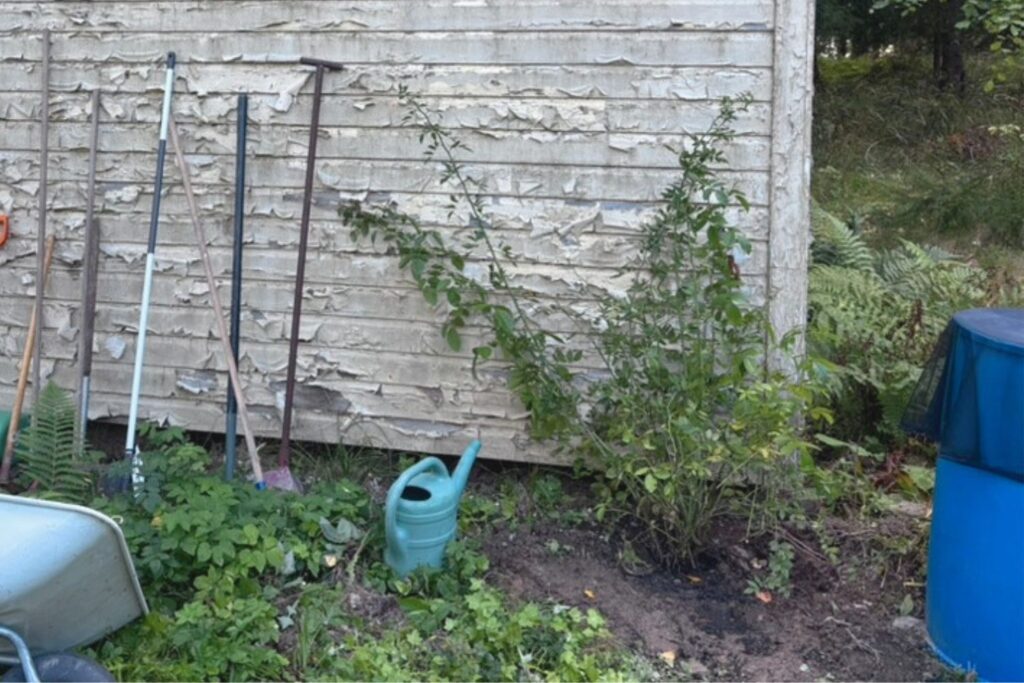
I want to be honest that this wasn’t an oversight. I knew, planting it, that I was creating a problem for a slightly later version of myself. But climbing roses like Flammentanz can be trained and bent, and the plan — such as it is — involves gently working the canes down and out of the way when painting season actually arrives, rather than avoiding the spot altogether now. It felt, at the time, like a reasonable trade: deal with an inconvenience later in exchange for giving the rose the strongest, sunniest wall on the property today. I stand by it, mostly. Ask me again once I’m up a ladder with a paintbrush in one hand and a climbing cane in the other.
There’s something in this small decision that feels true to the whole renovation, honestly — cottage and garden both. You rarely get to sequence everything perfectly. Sometimes the rose goes where the rose wants to go, and the wall gets painted around it, a little later and a little more carefully than it otherwise would have been.
Learning as You Go, Not Before
If there’s a single thing this first real gardening season has taught me, it’s that you don’t need to know what you’re doing before you start doing it. I didn’t. I still mostly don’t, if I’m honest — I’m learning the names of things after I’ve already planted them half the time, discovering what a plant actually needs by watching what happens when I guess wrong, adjusting the following week rather than getting it right the first time.
The garden, unlike some parts of a renovation, is remarkably forgiving of this approach. A misplaced plant can usually be moved. A bed that isn’t working can be reworked the following spring. Nothing here is quite as unforgiving as a wall you’ve already painted the wrong color or a fixture you’ve already installed in the wrong spot. There’s a kind of relief in that, once you notice it — permission to experiment, to get things wrong in full view, to let a wheelbarrow sit half-planted for longer than feels entirely tidy while you figure out the rest.
Late summer, specifically, feels like an honest moment to write this from. The garden isn’t at its most photogenic right now — spring’s freshness has passed, and the deliberate, tucked-in tidiness of autumn hasn’t arrived yet. It’s simply midway, a little tired in places, still deciding what it wants to become. That feels like an accurate description of most things worth doing slowly, garden included.
Where This Is Going
I don’t have a finished garden plan to hand you, and I’m not sure I will for a good while yet — this is very much a multi-year project, shaped one flower bed, one wheelbarrow load, one slightly inconvenient rose at a time. What I can offer, for now, is the same thing I try to offer with the rest of Nordic Quiet: the honest, unfinished middle of it, rather than a polished version that doesn’t exist yet.
If you’d like to follow along as the garden — and the rest of the cottage — keeps slowly taking shape, I share these small updates first through the newsletter, along with the free Scandinavian Cottage Moodboard if you’d like a quiet starting point for your own space. No pressure to have a plan yet. Neither do I, really. Just a wheelbarrow, a stubborn rose, and a lot of late-summer patience.
Nordic Quiet is a slow living journal following a Finnish cottage renovation, one unhurried season at a time.